
The Root Vegetable Traybake I Make on a Sunday
Roasted roots, lentils, and rapeseed oil. One tray, barely any effort, and it feeds you for days, with real evidence behind every part of it.

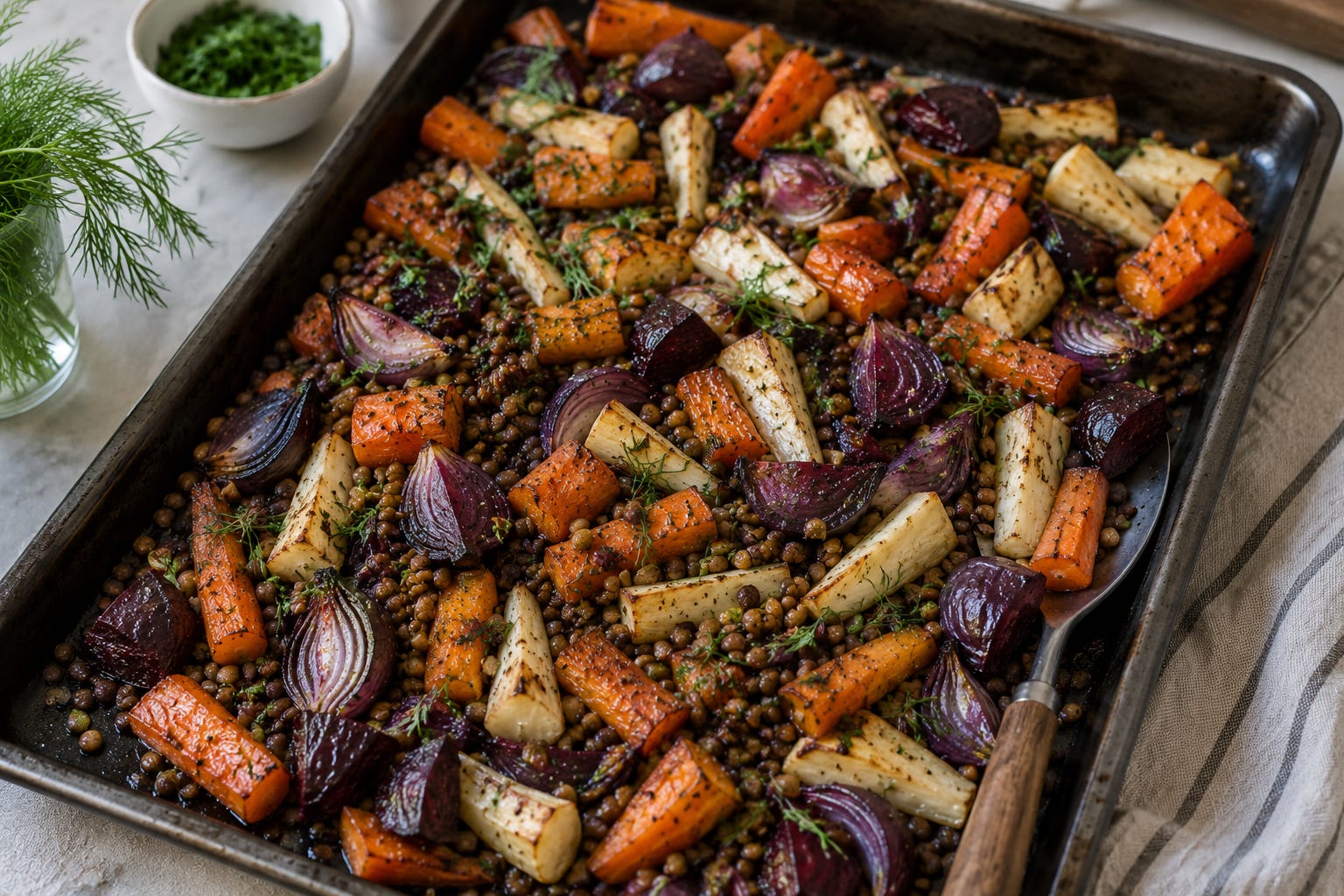
Root vegetables and rapeseed oil are as Nordic as fish, and this is the dish I make when I want good food with almost no effort. Everything goes on one tray, it roasts while you do something else, and the leftovers are genuinely worth having.
Why make this
Lentils actively lower LDL cholesterol. About one serving of pulses a day meaningfully reduces LDL in randomized trials [1].
Fibre that keeps you full and steady. Roots and lentils are fibre-rich, and pulses in particular increase fullness [2].
Effortless batch cooking. One tray, minimal work, four days of leftovers.
Cheap and seasonal. Root vegetables are among the most affordable, sustainable things you can cook.
When to eat this
This is a lunch or dinner workhorse. Roast it on a Sunday and it becomes weekday lunches over greens, or a fast dinner under a piece of fish. As a lunch it gives steady afternoon energy; as a dinner it is satisfying without being heavy.
Root Vegetable and Lentil Traybake
Serves 4 (or 2, with leftovers). Prep 15 minutes. Roast 35 minutes.
Ingredients
800 g mixed root vegetables (carrots, parsnips, beetroot, red onion), in chunks
2 tablespoons rapeseed (canola) oil
1 can (400 g) green or brown lentils, drained (or 250 g cooked)
Salt and black pepper
A handful of fresh herbs (dill, parsley, or thyme)
Optional: a spoon of skyr or yogurt to serve
Method
Heat the oven to 200°C (400°F). Toss the root vegetables with the rapeseed oil, salt, and pepper on a large tray in a single layer.
Roast 25 minutes.
Stir in the drained lentils and roast another 10 minutes, until the vegetables are tender and caught at the edges.
Scatter with fresh herbs. Serve as is, or with a spoon of skyr and a slice of rye bread.
Make it your own (US-friendly)
Root vegetables: any mix of carrots, parsnips, beets, sweet potato, or squash.
Rapeseed oil is canola oil in the US. Olive oil works too.
Lentils: canned is easiest. Chickpeas or white beans work equally well and carry the same LDL evidence.
Scaling and leftovers
Built for leftovers. It keeps four days and is excellent cold or gently reheated, over greens for lunch or under the salmon from the first recipe.
The science behind it
Root vegetables and rapeseed oil are core components of the healthy Nordic diet, the pattern with real cardiovascular evidence behind it [3]. But the standout ingredient here is the lentils.
Dietary pulses, beans, lentils, chickpeas, peas, have some of the cleaner evidence in nutrition. In a meta-analysis of 26 randomized trials, eating about 130 grams of pulses a day, roughly one serving, significantly lowered LDL cholesterol [1]. And in a separate analysis, pulses increased satiety, the feeling of fullness after a meal [2]. So this is not just a filling dinner. The lentils are doing measurable work on your cholesterol and your appetite.
Add the fibre from the roots, linked in large analyses to lower cardiovascular and all-cause mortality [3], and rapeseed oil for a favourable fat profile, and you have a plate where every component earns its place.
Tell me what to cook next. Would you like a one-pot dinner next, something warming you can make on a weeknight in under half an hour? Reply and I will write it up.
You may also like


If you would like all of my Plate recipes gathered into printable seasonal collections with meal plans and shopping lists, see the link below:
The Søberg® Plate 7-Day Plan #1

The Søberg® Plate 7-Day Plan. Paid, sent twice a month (1st and 3rd Thursday). Read it Thursday, shop over the weekend, cook from Monday.
Dr. Susanna Søberg, PhD
References
[1] Ha V, Sievenpiper JL, de Souza RJ, et al. Effect of dietary pulse intake on established therapeutic lipid targets for cardiovascular risk reduction: a systematic review and meta-analysis of randomized controlled trials. CMAJ. 2014;186(8):E252-E262. doi:10.1503/cmaj.131727
[2] Li SS, Kendall CWC, de Souza RJ, et al. Dietary pulses, satiety and food intake: a systematic review and meta-analysis of acute feeding trials. Obesity. 2014;22(8):1773-1780. doi:10.1002/oby.20782
[3] Reynolds A, Mann J, Cummings J, Winter N, Mete E, Te Morenga L. Carbohydrate quality and human health: a series of systematic reviews and meta-analyses. The Lancet. 2019;393(10170):434-445. doi:10.1016/S0140-6736(18)31809-9