
The Most Nordic Dinner There Is
Salmon, dill, cucumber, new potatoes. The plate I grew up with, done properly, and the science behind why it is worth making tonight.

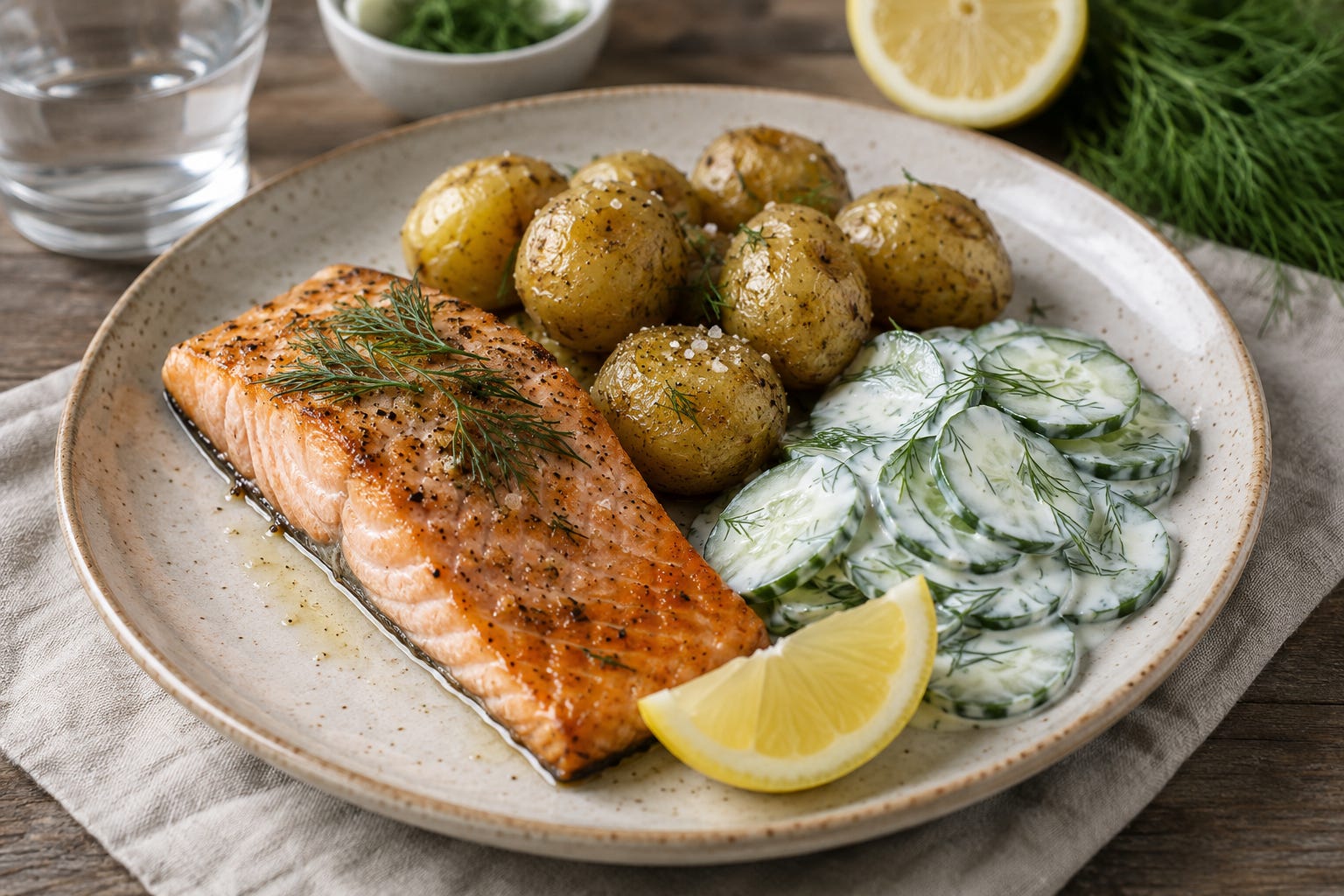
If you asked me to put the Nordic way of eating on a single plate, this would be it. Oily fish, roasted just enough. Cool cucumber folded through dill and skyr. Small new potatoes, cooked whole so they stay firm. It is the food I grew up with in Denmark, it takes barely half an hour, and it sits on some of the better evidence in nutrition science.
Why make this
Protein that keeps you full for hours. Salmon is high-quality protein, and protein is the most satiating thing you can put on a plate, which is why this dinner does not leave you raiding the cupboard at nine.
It belongs to a way of eating with real evidence. The healthy Nordic diet this plate comes from lowered LDL cholesterol by around 21 percent and reduced blood pressure in a randomized trial [1].
Kinder to your blood sugar. Keeping the potatoes whole and firm, rather than mashed, gives a gentler rise in blood sugar than most potato dishes.
Genuinely fast. Half an hour, one tray, minimal washing up.
When to eat this
This is a dinner. It is ideal in the evening because it is protein-forward and light, which sits comfortably before sleep, and it gives you leftover salmon for the next day. If you eat it earlier, the protein and fibre make it a steady, no-crash lunch too.
Baked Salmon with Dill, Cucumber, and New Potatoes
Serves 2. Prep 15 minutes. Cook 25 minutes.
Ingredients
For the plate:
2 salmon fillets, skin on, about 150 g each
500 g new potatoes (small waxy potatoes), skin on
1 tablespoon rapeseed oil (canola oil), plus a little extra
Salt and black pepper
1 lemon, half juiced, half in wedges
For the cucumber and dill:
Half a cucumber, thinly sliced
3 tablespoons skyr or plain yogurt
1 small handful fresh dill, chopped
1 teaspoon white wine vinegar or lemon juice
A pinch of salt
Method
Potatoes first. Heat the oven to 200°C (400°F). Put the new potatoes, whole and unpeeled, into cold salted water, bring to a boil, and simmer 12 to 15 minutes until just tender. Drain them while still firm. Kept whole, they give a gentler blood-sugar response than mash.
The cucumber side. While the potatoes cook, stir together the skyr, dill, vinegar, and a pinch of salt, then fold in the cucumber. Chill it while you cook the rest.
The salmon. Place the fillets skin-side down on a lined tray. Rub with the rapeseed oil, season, and squeeze over the juice of half the lemon. Bake 10 to 12 minutes, until just opaque and flaking gently. Pull it a touch early; salmon keeps cooking out of the oven, and this is how you avoid it drying out.
Finish the potatoes. Drain, and if you like, crush each lightly with a fork and toss with a little rapeseed oil, salt, and pepper.
Plate. Salmon, potatoes, a generous spoon of the cucumber and dill, lemon wedges alongside.
Make it your own (US-friendly)
The fish: trout, mackerel, or arctic char are excellent, often cheaper, swaps. Frozen salmon, thawed, works perfectly.
Rapeseed oil is simply canola oil in the US. Olive oil is fine.
New potatoes: any small waxy potato. Skip large starchy baking potatoes here.
Skyr is now in many US supermarkets. Plain Greek yogurt is a direct substitute.
Scaling and leftovers
Halve for one, double for four (keep the salmon in a single layer so it roasts, not steams). Leftover salmon is wonderful cold the next day, flaked over a rye and skyr bowl or through a salad.
The science behind it
Both halves, even about my own national cuisine.
The strong half is genuinely strong. This plate belongs to the healthy Nordic diet, and that pattern has been tested in real randomized trials. In the NORDIET study, people with high cholesterol saw LDL fall around 21 percent, with lower blood pressure and modest weight loss, against a control diet [1]. In SYSDIET, people with metabolic syndrome improved their blood lipids and inflammatory markers on an isocaloric Nordic diet [2].
The other half: in that same SYSDIET trial, insulin sensitivity and blood pressure did not significantly change once calories were matched [2]. So this is not a metabolic miracle. Its clearest, best-supported benefits are for your blood lipids and cardiovascular risk. That is real, and it is enough.
The salmon itself brings high-quality protein for your muscle and glucose handling, and long-chain omega-3 fats, which are involved in how your body manages inflammation. The whole, firm potatoes add fibre, and dietary fibre in this range is linked in large analyses to lower cardiovascular and all-cause mortality [3].
Before you cook
This is not a medicinal meal and I will never dress a plate of dinner up as one. It is real, nutritious food that belongs to a way of eating with genuine evidence behind it. Good food, eaten often. That is the point.
Tell me what to cook next. Would you like a make-ahead breakfast next, one you build the night before so mornings need no thought? Reply and tell me, and I will send it.
You may also like


If you would like all of my Plate recipes gathered into printable seasonal collections with weekly meal plans and shopping lists, below are the links.
The Søberg® Plate 7-Day Plan #1

The Søberg® Plate 7-Day Plan. Paid, sent twice a month (1st and 3rd Thursday). Read it Thursday, shop over the weekend, cook from Monday.
Dr. Susanna Søberg, PhD
References
[1] Adamsson V, Reumark A, Fredriksson IB, et al. Effects of a healthy Nordic diet on cardiovascular risk factors in hypercholesterolaemic subjects: a randomized controlled trial (NORDIET). Journal of Internal Medicine. 2011;269(2):150-159. doi:10.1111/j.1365-2796.2010.02290.x
[2] Uusitupa M, Hermansen K, Savolainen MJ, et al. Effects of an isocaloric healthy Nordic diet on insulin sensitivity, lipid profile and inflammation markers in metabolic syndrome: a randomized study (SYSDIET). Journal of Internal Medicine. 2013;274(1):52-66. doi:10.1111/joim.12044
[3] Reynolds A, Mann J, Cummings J, Winter N, Mete E, Te Morenga L. Carbohydrate quality and human health: a series of systematic reviews and meta-analyses. The Lancet. 2019;393(10170):434-445. doi:10.1016/S0140-6736(18)31809-9