
The Five-Minute Mackerel Rye, the Omega-3 Lunch I Come Back To
A cold, no-cook open rye sandwich with mackerel, the quickest way I know to get real omega-3 and protein into the middle of a busy day. A Danish everyday lunch for the Plate.

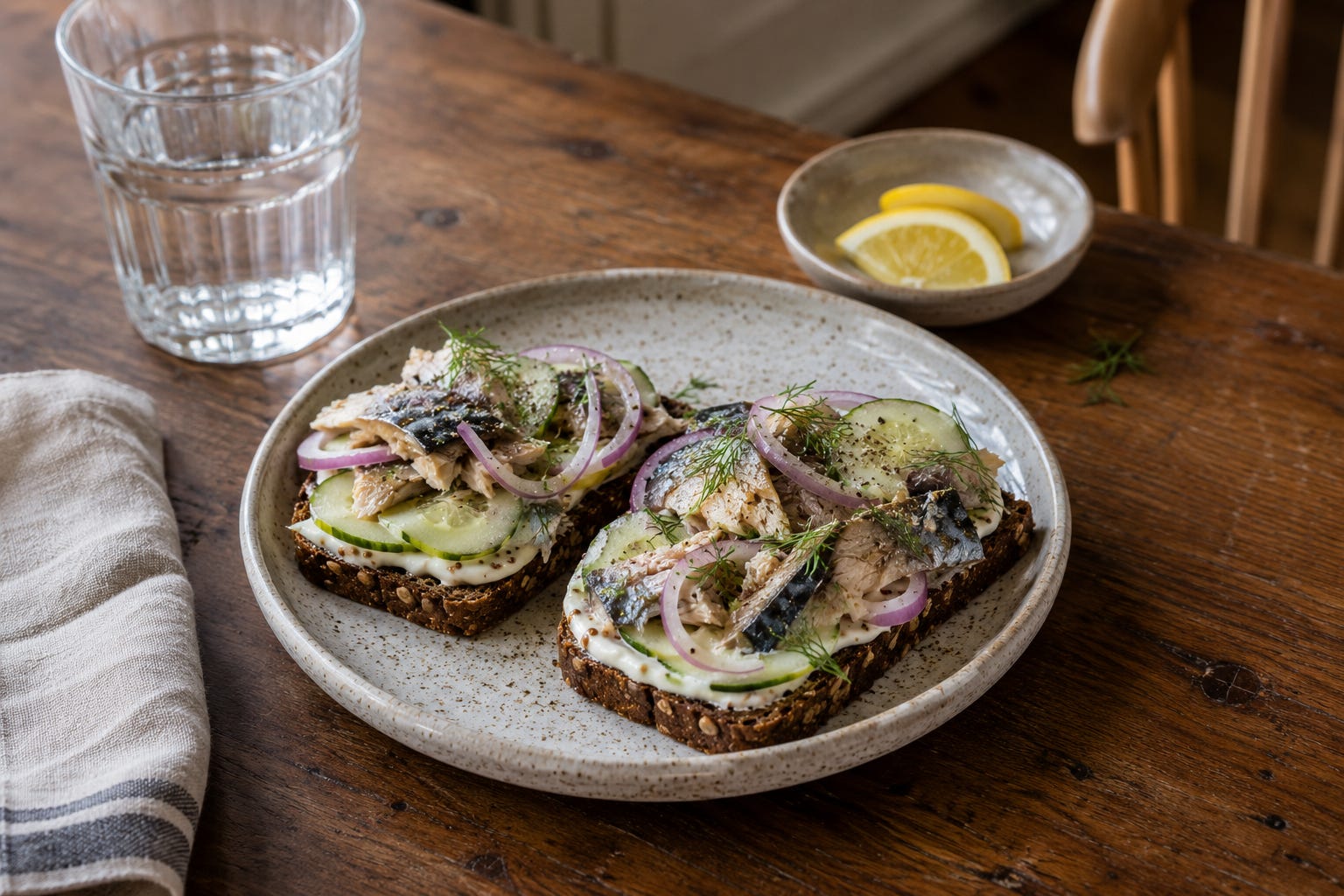
Not every meal needs a pan. This is the lunch I make when I have five minutes and want something that really holds me: mackerel on rye, the open sandwich I grew up with, and one of the simplest ways to eat oily fish without cooking anything at all.
I want this science out where people can read it, so every new piece is open to everyone for the first month. This one is free until 17th September 2026, then it joins the members’ archive.
Subscribe free and the open pieces land in your inbox as they publish. Nothing to pay, nothing missed.
Members get the deep dives as well: the protocols, the doses, the exact how.
Why make this
Oily fish without the effort, tinned mackerel gives you real omega-3 and protein with no cooking.
Dense rye, not white bread, so it steadies your blood sugar instead of spiking it.
Five minutes, no heat, the meal for days you have no time.
Genuinely Danish, the open rye sandwich is how we really eat here.
The Five-Minute Mackerel Rye
Serves 1. 5 minutes.
Ingredients
2 slices dense rye bread (rugbrød)
1 tin mackerel (in olive oil or tomato), drained
2 tablespoons Greek yogurt or a little mayonnaise
1 teaspoon Dijon or wholegrain mustard
A few slices of cucumber
Red onion, thinly sliced
Fresh dill or chives
Lemon, pepper
Method
Mix the yogurt with the mustard and a squeeze of lemon.
Spread it over the rye.
Flake the mackerel on top.
Finish with cucumber, a little red onion, dill, and a good grind of pepper.
Make it your own (US-friendly)
Fish: tinned mackerel is the star, but tinned sardines or good tuna work too.
Bread: any dense wholegrain rye. The denser and darker, the better for steady energy.
Fresh: capers, radish, or a boiled egg on top all belong here.
Scaling
Make two if you are hungry. The mackerel mix keeps a day in the fridge if you prepare it ahead.
The science behind it
This little lunch does something most quick meals do not: it gets oily fish into your day. Omega-3 has its strongest evidence in people who eat little oily fish, and for specific cardiovascular uses [1], so a food source like mackerel is a genuinely useful, unhyped way to get it, food first, before any supplement.
The rye matters as much as the fish, and here the evidence is genuinely strong. In Denmark we eat rye bread almost every day, and it turns out to be one of the better everyday choices you can make. In controlled crossover trials, wholegrain rye bread produces a markedly lower insulin response than white wheat bread [2, 3], an effect studied so consistently it has a name in the research: the rye factor. The mechanism is elegant, glucose enters the bloodstream more slowly after rye than after wheat, so your body needs less insulin to handle the same meal [3]. Rye products also improve the glycaemic profile and appear to regulate appetite, with a gentler, longer-lasting release rather than a spike and crash [4].
I want to be precise, because precision is the point of this journal: the clearest difference is in insulin, not always in peak blood sugar itself. But a lower insulin demand, meal after meal, day after day, is exactly the kind of quiet, repeated advantage that adds up. Swap white bread for dense wholegrain rye and you are making one of the simplest, best-evidenced upgrades in your day.
With the protein from the fish and this steady rye base together, the sandwich holds you through the afternoon rather than sending you up and crashing you, the difference between a lunch that lasts and one that leaves you hungry by three.
Simple, fast, and quietly one of the better lunches you can eat.
Tell me what to cook next
Would a high-protein breakfast help, the meal where protein is most often too low? Reply and I will send one.
You may also like
The Warming Chili and White Bean Fish Pot (recipe) [drop link]
From The Journal: Which Supplements Are Worth Your Money [drop link]
Dr. Susanna Søberg, PhD
References
[1] Hu Y, Hu FB, Manson JE. Marine Omega-3 Supplementation and Cardiovascular Disease: An Updated Meta-Analysis of 13 Randomized Controlled Trials Involving 127,477 Participants. Journal of the American Heart Association. 2019;8(19):e013543. doi:10.1161/JAHA.119.013543
[2] Leinonen K, Liukkonen K, Poutanen K, Uusitupa M, Mykkänen H. Rye bread decreases postprandial insulin response but does not alter glucose response in healthy Finnish subjects. European Journal of Clinical Nutrition. 1999;53(4):262-267. doi:10.1038/sj.ejcn.1600716
[3] Eriksson JW, et al. Glucose Appearance Rate Rather than the Blood Glucose Concentrations Explains Differences in Postprandial Insulin Responses between Wholemeal Rye and Refined Wheat Breads. Molecular Nutrition & Food Research. 2019;63(6):e1800750. doi:10.1002/mnfr.201800750
[4] Rosén LA, Silva LO, Andersson UK, Holm C, Östman EM, Björck IM. Endosperm and whole grain rye breads are characterized by low post-prandial insulin response and a beneficial blood glucose profile. Nutrition Journal. 2009;8:42. doi:10.1186/1475-2891-8-42
[5] Reynolds A, Mann J, Cummings J, Winter N, Mete E, Te Morenga L. Carbohydrate quality and human health: a series of systematic reviews and meta-analyses. The Lancet. 2019;393(10170):434-445. doi:10.1016/S0140-6736(18)31809-9