
The Everyday Lentil Soup That Keeps You Full for Hours
A warm, spiced lentil soup, protein and fibre in a bowl, built to steady your blood sugar and keep hunger away all afternoon. A different shape of meal for the Plate.

I want this science out where people can read it, so every new piece is open to everyone for the first month. This one is free until 19th September 2026, then it joins the members’ archive.
Subscribe free and the open pieces land in your inbox as they publish. Nothing to pay, nothing missed.
Members get the deep dives as well: the protocols, the doses, the exact how.
I have given you plates and bowls, so here is something different in shape: a soup. This is the pot I make when I want one thing on the stove that feeds me for days, warm, filling, and quietly one of the most blood-sugar-steadying meals there is.
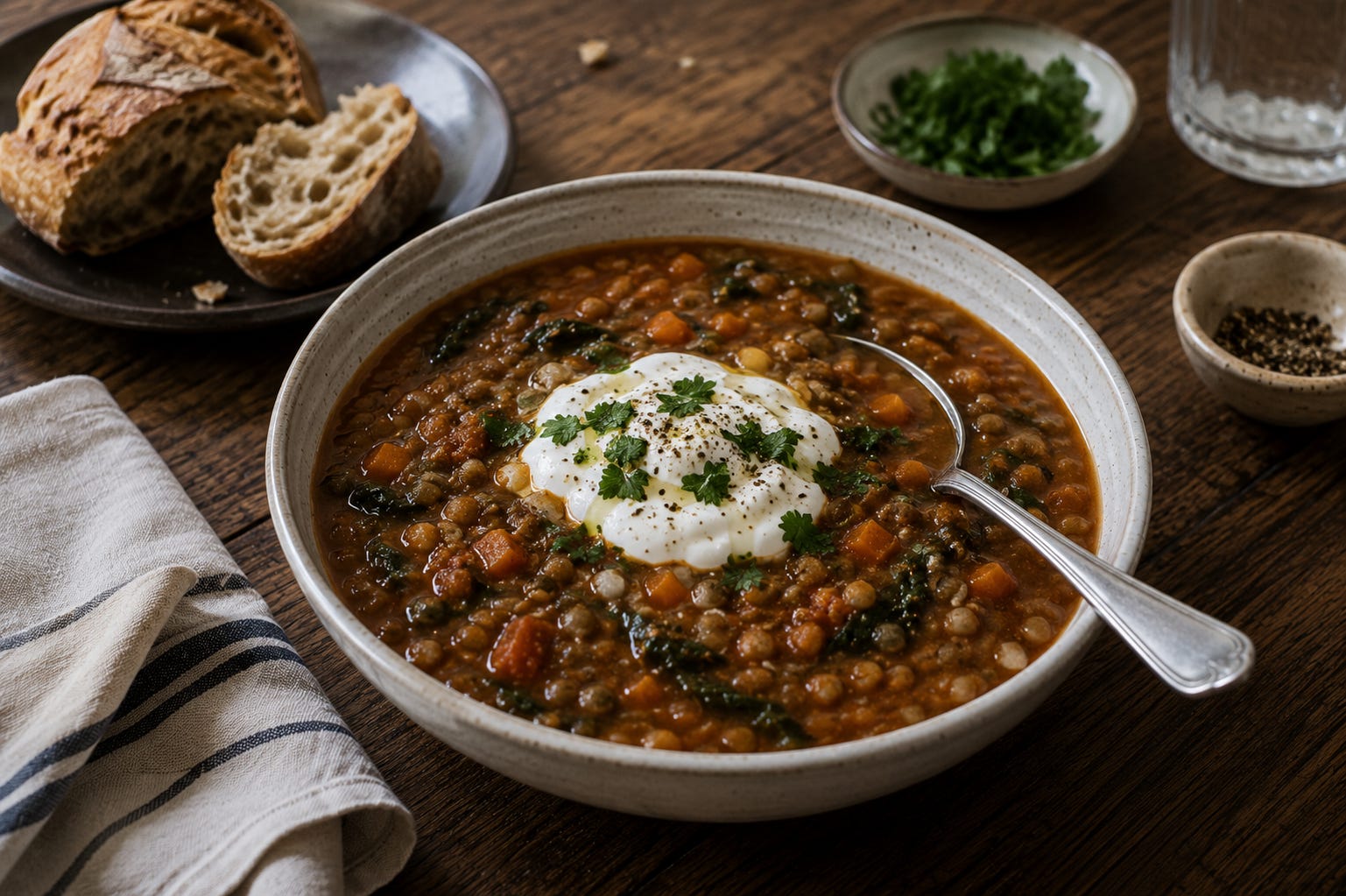
Why make this
Lentils do two jobs at once, protein and fibre in the same spoon, which is why this keeps you full for hours rather than an hour.
One pot, and it is better on day two, so it earns its place in a busy week.
Naturally steadying, the fibre in lentils flattens the blood-sugar curve that drives afternoon crashes.
Cheap and humble, real everyday food, not a project.
The Everyday Lentil Soup
Serves 4. 35 minutes.
Ingredients
300 g dried green or brown lentils, rinsed (or 2 cans, drained)
1 onion, diced
2 carrots, diced
2 celery sticks, diced
3 cloves garlic, chopped
2 teaspoons ground cumin
1 teaspoon smoked paprika
1 can (400 g) chopped tomatoes
1.2 litres vegetable or chicken stock
2 tablespoons olive oil
A big handful of spinach or kale
Lemon, salt, pepper
Plain yogurt to serve
Method
Heat the olive oil in a large pot. Soften the onion, carrot, and celery for 8 minutes.
Add the garlic, cumin, and paprika, and stir for a minute until fragrant.
Add the lentils, tomatoes, and stock. Bring to a boil, then simmer for 25 to 30 minutes, until the lentils are soft (less if using canned, about 12 minutes).
Stir in the greens and let them wilt. Season with salt, pepper, and a good squeeze of lemon.
Serve with a spoon of yogurt on top and bread alongside if you like.
Make it your own (US-friendly)
Lentils: green or brown hold their shape; red lentils make it smoother and quicker.
Heat: a pinch of chili or a spoon of harissa lifts it.
Heartier: add cooked sausage or leftover chicken, though it is a full meal without.
Scaling
Doubles easily and freezes well. Make the full pot; it is your lunch for three days.
The science behind it
Lentils are the reason this meal keeps you full and steady. They are one of the best whole-food sources of protein and fibre at once, and pulses specifically have real evidence behind them: about a serving of beans or lentils a day significantly lowers LDL cholesterol in trials [1], and pulses increase fullness and reduce later food intake [2]. The fibre also flattens the blood-sugar rise and fall that drives afternoon slumps, and a higher-fibre pattern is linked to better long-term metabolic health [3].
This is additive eating at its simplest. One humble pot gives you protein, fibre, vegetables, and a meal that genuinely holds you, which is worth far more than most of what gets sold as “healthy.”
Tell me what to cook next
Want a fish version of an easy weeknight meal next? Reply and I will send one.
You may also like
The Root Vegetable and Lentil Traybake (recipe) [drop link]
From The Journal: Which Supplements Are Worth Your Money [drop link]
Dr. Susanna Søberg, PhD
References
[1] Ha V, Sievenpiper JL, de Souza RJ, et al. Effect of dietary pulse intake on established therapeutic lipid targets for cardiovascular risk reduction: a systematic review and meta-analysis of randomized controlled trials. CMAJ. 2014;186(8):E252-E262. doi:10.1503/cmaj.131727
[2] Li SS, Kendall CWC, de Souza RJ, et al. Dietary pulses, satiety and food intake: a systematic review and meta-analysis of acute feeding trials. Obesity. 2014;22(8):1773-1780. doi:10.1002/oby.20782
[3] Reynolds A, Mann J, Cummings J, Winter N, Mete E, Te Morenga L. Carbohydrate quality and human health: a series of systematic reviews and meta-analyses. The Lancet. 2019;393(10170):434-445. doi:10.1016/S0140-6736(18)31809-9