
How to Bake Real Danish Rye Bread (Rugbrød), the Loaf We Eat Almost Every Day
The dense, dark, seed-packed rye bread that is the base of Danish lunch, and one of the best-evidenced everyday choices for steady blood sugar. No sourdough starter needed.

I want this science out where people can read it, so every new piece is open to everyone for the first month. This one is free until 17th September 2026, then it joins the members’ archive.
Subscribe free and the open pieces land in your inbox as they publish. Nothing to pay, nothing missed.
Members get the deep dives as well: the protocols, the doses, the exact how.
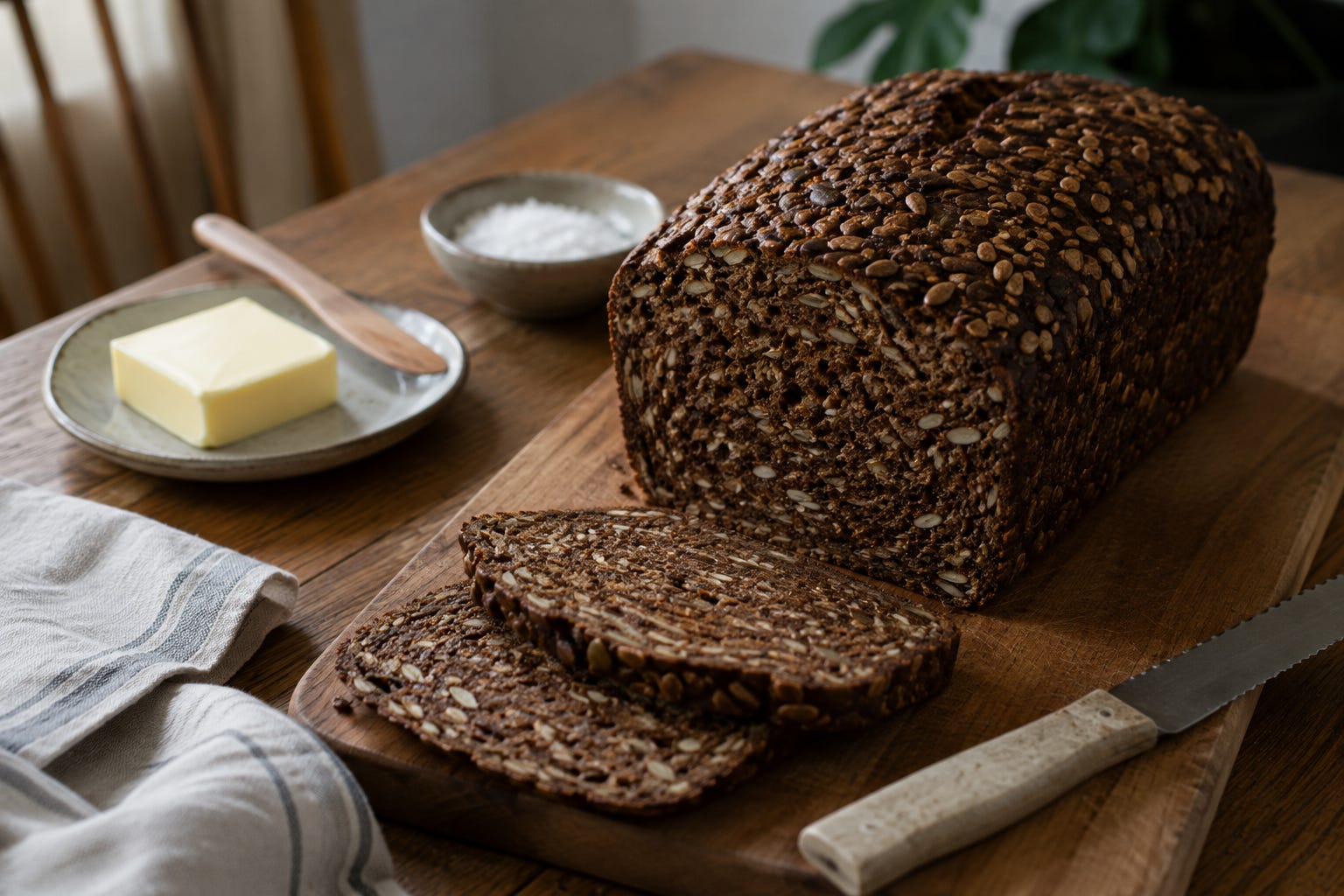
If you have ever tried to buy real Danish rye bread outside Scandinavia, you know the problem: what most shops sell as “rye” is light wheat bread with a little rye flavour, nothing like the dense, dark loaf we eat here. So here is how to make the real thing at home, and I have written it for a kitchen that does not keep a rye sourdough starter, because most do not. This version uses ordinary yeast and an overnight soak, and it is close to foolproof.
In Denmark we eat rugbrød almost every day, usually as the base of an open sandwich at lunch. It is not a side. It is a staple, and it happens to be one of the best everyday choices you can make for steady energy.
Why bake this
You cannot easily buy the real thing outside Scandinavia, so making it is the only way to eat it properly.
No starter, no kneading, just an overnight soak and a mix. The dough is more like a thick batter than a bread dough, and that is exactly right.
It keeps for a week wrapped, and freezes well sliced, so one bake feeds many lunches.
Dense, dark, and genuinely filling, one thin slice with a topping holds you for hours.
Danish Rye Bread (Rugbrød), overnight yeast method
Makes 1 large loaf. About 20 minutes of work, plus an overnight soak and rise, plus baking.
You will need a large loaf tin, ideally a Pullman-style tin around 9 to 13 inches. A standard large loaf tin works too.
The soaker (make the night before)
200 g (about 1.5 cups) whole rye kernels or cracked rye (or use rye flour if you cannot find kernels)
100 g (about 3/4 cup) mixed seeds: sunflower, pumpkin, flax, sesame
1 teaspoon salt
400 ml (about 1.75 cups) water or buttermilk
Combine in a bowl, cover, and leave at room temperature overnight (8 to 12 hours). The soak softens the grains and deepens the flavour.
The dough (next day)
All of the soaker
300 g (about 2.5 cups) wholegrain rye flour (dark rye)
100 g (about 3/4 cup) bread flour or whole wheat flour (helps it slice cleanly)
1 packet (7 g) instant yeast
1 tablespoon dark treacle, molasses, or malt syrup (for colour and a faint malty note)
250 ml (about 1 cup) warm water
Method
Mix the yeast and warm water with the treacle until dissolved.
Add this to the soaker along with both flours. Stir well with a wooden spoon until fully combined. The dough will be thick, wet, and clay-like, not kneadable. That is correct, do not add flour to firm it up.
Grease your loaf tin well and dust with rye flour. Scrape the dough in, press it level with a wet spoon, and smooth the top.
Cover loosely and let rise at room temperature for 2 to 3 hours, until it has risen noticeably and small holes appear on the surface.
Heat the oven to 180C (350F). Bake for 60 to 75 minutes. The loaf is done when the internal temperature reaches about 98C (208F), or when it sounds hollow tapped on the base.
This is the hard part: let it cool completely, then wrap it and wait until the next day before slicing. Rye needs time to set its crumb, and slicing warm gives you a sticky inside. Patience is part of the recipe.
Make it your own (US-friendly)
Rye flour: look for dark or wholegrain rye flour. Bob’s Red Mill dark rye is widely available in the US. Avoid “light rye,” which is refined.
Rye kernels: if you cannot find whole or cracked rye, increase the rye flour and add extra seeds for texture.
Buttermilk in the soaker gives a gentle tang closer to the sourdough original, but water works fine.
Seeds: any mix. Sunflower and flax are the classic base.
Serving it the Danish way
Slice thin. Butter it. Use one slice as the base for an open sandwich with one topping, mackerel, egg, cheese, smoked fish, eaten with a knife and fork. It is never a stacked two-slice sandwich. That is smorrebrod, and it is how we eat lunch.
The science behind it
This is where rye earns its place in your week, and the evidence is genuinely strong.
In controlled crossover trials, wholegrain rye bread produces a markedly lower insulin response than white wheat bread [1, 2]. The effect is so consistent it has a name in the research: the rye factor. The mechanism is elegant, glucose enters the bloodstream more slowly after rye than after wheat, so your body needs less insulin to handle the same meal [2]. Rye also improves the glycaemic profile and appears to help regulate appetite, giving a gentler, longer-lasting release rather than a spike and a crash [3].
I want to be precise, because precision is the point of this journal: the clearest, most consistent difference is in insulin, not always in the peak blood sugar itself. But a lower insulin demand, meal after meal, day after day, is exactly the kind of quiet, repeated advantage that adds up over a lifetime of daily bread. And real rugbrod is 100 percent wholegrain rye plus seeds, so it carries more fibre than most commercial wholegrain wheat bread, and a higher-fibre pattern is linked to better long-term metabolic and cardiovascular health [4].
This is why we eat it every day and why I wanted you to be able to make it. It is not a health fad. It is a centuries-old staple that the science happens to have caught up with.
Tell me how it goes
Baking rye for the first time can feel strange, the wet dough, the long wait. Reply and tell me how your loaf turns out, or ask me anything before you start.
You may also like
The Five-Minute Mackerel Rye (the lunch to make with this loaf) [drop link]
The Overnight Rye and Berry Bowl (recipe) [drop link]
Dr. Susanna Søberg, PhD
References
[1] Leinonen K, Liukkonen K, Poutanen K, Uusitupa M, Mykkänen H. Rye bread decreases postprandial insulin response but does not alter glucose response in healthy Finnish subjects. European Journal of Clinical Nutrition. 1999;53(4):262-267. doi:10.1038/sj.ejcn.1600716
[2] Eriksson JW, et al. Glucose Appearance Rate Rather than the Blood Glucose Concentrations Explains Differences in Postprandial Insulin Responses between Wholemeal Rye and Refined Wheat Breads. Molecular Nutrition & Food Research. 2019;63(6):e1800750. doi:10.1002/mnfr.201800750
[3] Rosén LA, Silva LO, Andersson UK, Holm C, Östman EM, Björck IM. Endosperm and whole grain rye breads are characterized by low post-prandial insulin response and a beneficial blood glucose profile. Nutrition Journal. 2009;8:42. doi:10.1186/1475-2891-8-42
[4] Reynolds A, Mann J, Cummings J, Winter N, Mete E, Te Morenga L. Carbohydrate quality and human health: a series of systematic reviews and meta-analyses. The Lancet. 2019;393(10170):434-445. doi:10.1016/S0140-6736(18)31809-9